-
- Author
- Cannon Financial Institute
-
- Published
- March 3, 2025
Articles
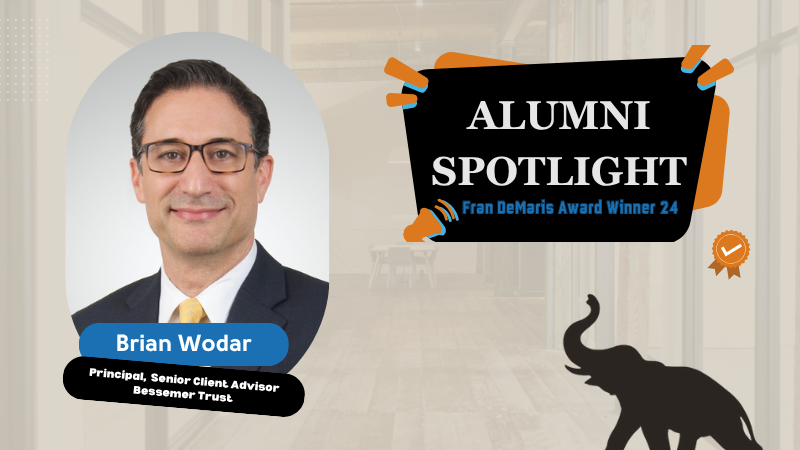
Fran DeMaris Award Winner 2024: Brian Wodar
Cannon Financial Institute uses the Fran DeMaris Award to recognize outstanding individuals in the trust and estate planning industry who partake in their Trust School. Recently, Brian Wodar, Senior Client Advisor at Bessemer Trust, earned this prestigious accolade.
To earn the Fran DeMaris Award, a candidate must not only graduate from Cannon Trust School I and II with honors but also meet additional criteria, such as obtaining strong recommendations from supervisors and fulfilling other specific requirements.
Cannon Financial Institute alumni often arrive with unique journeys. For Brian Wodar, the path to trust and estate planning began not with finance, but with fiction.
Armed with a master’s in literature, Brian spent five years teaching college students before realizing the classroom wasn’t quite where he belonged. He pivoted into wealth management in 1997—and found himself educating in a different way entirely. “I thought I was leaving education behind,” Brian recalls. “But I really haven’t. A big part of what I do is still teaching—my clients, my coworkers, even those who once managed me.”
Over the course of his nearly 30-year career, Brian has worked in New York, Chicago, and now Florida. He’s guided clients through complex planning scenarios, led teams, and built an extensive technical toolbox. But it wasn’t until five years ago, when he joined a trust company for the first time, that he realized he was missing a piece of the puzzle. “Suddenly, I wasn’t referring things out—I was in the middle of it,” he says. “I knew I needed to sharpen the tools I had, and quickly.”
That’s when a colleague at Bessemer Trust suggested the CTFA™ and recommended Cannon. Brian enrolled, and what followed was a career-defining experience.
A Real-World Classroom Experience
Brian completed all three years of Cannon Trust School in South Bend, IN, a campus he’d never visited before but quickly came to appreciate. “It was beautiful, walkable, and really conducive to study groups,” he says. “I’m a creature of habit, so once I went the first year, I knew I’d return.”
He came to every class with two sets of notes—one for the exam, and one for real-time client application. “I remember one week in year two, we were deep into generation-skipping transfer tax, and I had a client case that paralleled almost everything we discussed. I was emailing my team from class with suggestions,” Brian says. “I didn’t even have to wait to get back to the office.”
That immediate applicability was a major differentiator for Brian. “It wasn’t just academic. What I learned had direct impact on how I serve clients,” he adds. “Cannon helped me internalize technical knowledge so it became part of my instinctive approach.”
The Value of Listening Before Advising
Brian’s early work in analytics trained him to reach conclusions quickly. But as he transitioned into client-facing roles, he realized he needed to slow down. “In the beginning, I’d jump into solutions too fast,” he says. “Now, I know to pause. If I think I’ve got the answer, that’s exactly when I need to ask more questions.”
He describes his role as one that’s “80% listening and 20% advising.” He focuses on understanding the client’s true definition of success—then and only then does he begin applying the tools in his kit. “Eventually, yes, you give advice. But if you haven’t deeply listened first, your advice won’t hit the mark.”
It’s this measured, client-first mindset that defines Brian’s approach—and it’s something he believes Cannon reinforced. “Cannon isn’t just about passing an exam,” he says. “It’s about learning how to think as a trusted advisor.”
Building Professional Confidence
Although Brian brought 25 years of experience into Cannon, he never felt above the material. In fact, he found it refreshing to return to a structured learning environment that respected his time.
“We’ve all been in professional training that drags,” he notes. “Four days of material that could have been an email. Cannon isn’t that. The content is rich, and the instructors are phenomenal—engaging, experienced, and ready to adapt to the real questions we had.”
He also appreciated the professionalism of Cannon’s staff. “Lisa and her team handle everything so well—it makes the whole experience smoother.”
For Brian, Trust School helped transition his knowledge from theory to practice—and boosted his confidence in high-stakes conversations. “When I sit down with clients, attorneys, or accountants now, I know I’m bringing real value. That’s the Cannon effect.”
Peer Networks That Last
Despite being deep into his career when he attended Cannon, Brian still found value in the peer network. He formed group chats with classmates—fellow professionals from other firms and roles—and those groups remain active to this day. “It’s quiet for weeks, and then someone throws out a question and the conversation lights up again,” he says. “We all bring different perspectives, and it’s still helpful.”
Protecting Balance in a Demanding Field
Brian acknowledges that wealth management—especially in trust and estate planning—can be an intense profession. His practice in Southwest Florida is seasonal, with workloads peaking from October to April. But even in the busy season, he sets boundaries.
“My clients can get in touch with me 24/7, but unless it’s truly urgent, we try to keep it within business hours to respect their personal time – and my own.”
This modeling isn’t just for clients—it’s for his team. “I want them to see it’s okay to disconnect,” he says.
To support his productivity, Brian also credits David Allen’s Getting Things Done, which helped him free his mind from mental task overload. “Instead of juggling 12 things in my head, I now trust the system. I can focus on what’s in front of me and be fully present—in work and in life.”
Advice for Future Cannon Students
While Brian completed Trust School over three years, he believes that pacing was perfect. “Could I have done it faster? Maybe. But I needed time to absorb and apply,” he says. “Each year built on the last. By the time I returned for year three, the earlier material was no longer memorized—it was lived experience.”
His advice for incoming students is to expect immediate application. “Come in ready to learn and implement,” he says. “Even if you’re experienced, you’ll walk away sharper. And if you’re newer, it’s an invaluable foundation.”
A Lifelong Educator at Heart
Brian Wodar may have traded the classroom for client meetings, but his love for teaching never left. Whether coaching colleagues, advising clients, or fielding peer questions in a group chat, he’s always in educator mode.
“The trust industry requires more than technical expertise—it requires communication, empathy, and curiosity,” he says. “Cannon helped me develop all of those. It made me a better advisor.”
And in doing so, it affirmed what he suspected all along: good advising is simply good teaching, with higher stakes and deeper rewards.